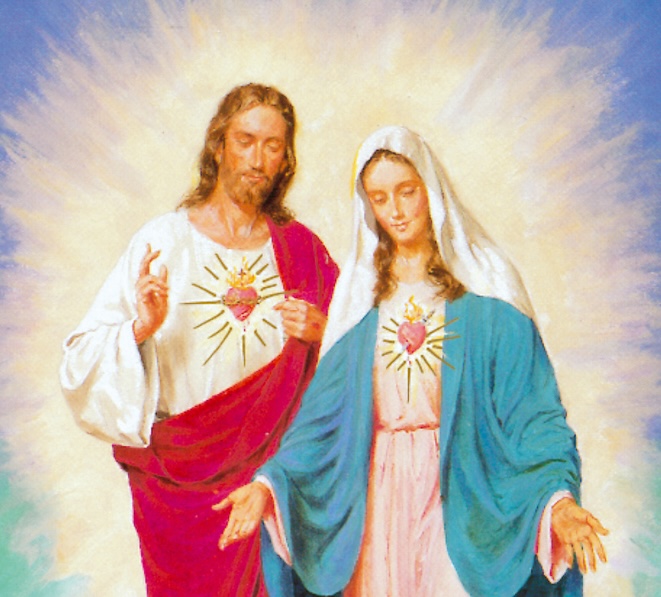
The Feast of the Most Sacred Heart of Jesus and the Memorial of the Immaculate Heart of the Blessed Virgin Mary are celebrated on June 12 and June 13, 2026, respectively.
The Most Sacred Heart of Jesus
To encounter God, who is Love (1 Jn 4:8), is to journey into the depths of one’s heart, where through prayer and trustful surrender we encounter both love and the One who is Love. The heart is often described as the “seat of emotions” and the center of our being, the place where joy and happiness, fear and anxiety, sadness and grief, hope and consolation converge.
In the Gospel of John, Jesus invites us to “abide in my love, just as I abide in my Father’s love” (Jn 15:9). Using the image of the vine and the branches, He teaches that those who remain united to Him will bear much fruit and glorify the Father. What better place to abide than in the Sacred Heart of Jesus, where we will find rest for our souls.
Jesus Himself says: “Take my yoke upon you and learn from me; for I am gentle and humble of heart, and you will find rest for your souls” (Mt 11:29). His Heart is the source of divine compassion and mercy. Throughout His public ministry, we see that compassion expressed in action. He raised the daughter of Jairus, healed the woman suffering from hemorrhages, restored sight to the blind, and delivered those afflicted by evil spirits (Mt 9:18–33). Again and again, Jesus revealed the tender love of His Heart.
Many find it difficult to experience God’s unconditional love because the human heart has been wounded by sin. Original sin has left us with divided hearts, where love and selfishness, trust and doubt, humility and pride, forgiveness and resentment often struggle for dominance. Scripture reminds us that “the inclination of the human heart is evil from youth” (Gen 8:21). Yet God, in and through the merciful and compassionate Heart of His Son Jesus, does not abandon us. He forgives and restores because He remembers that we are frail and dependent upon Him, that we are but flesh. (Ps 78:38–39).
The devotion to the Sacred Heart reminds us that Christ invites us to bring our wounded hearts to His wounded Heart. There we encounter transforming grace. As the prophet Ezekiel foretold, God desires to remove our hearts of stone and give us hearts of flesh (Ezek 36:26). Through His love, our hearts are renewed and become instruments of compassion, mercy, and charity toward others.
Let us therefore find our rest in the Sacred Heart of Jesus. By abiding in His love, we are transformed into faithful disciples who bear lasting fruit and witness to the mercy of God in the world (Jn 15:8,16).
The Immaculate Heart of Mary
Devotion to the Immaculate Heart of Mary invites us to contemplate Mary’s interior life, her virtues, and her perfect love for God, her Son Jesus Christ, and all humanity. This devotion is rooted in the biblical understanding of the heart as the center of the human person, encompassing intellect, emotion, will, and moral choice.
In the Hebrew tradition, the heart was the unified center of human experience encompassing not just the seat of emotions but ones thought, decision, volition, and action, the entire person. To love God with one’s whole heart meant to love Him with one’s entire person, one’s entire being.
The traditional image of the Immaculate Heart contains several important symbols. Each of these depict scriptural and theological realities. The Flames represent a heart burning with the fire of divine love. Jesus declared, “I came to bring fire upon the earth, and how I wish it were already blazing” (Lk 12:49). In Mary, that desire was perfectly fulfilled.
The Sword recalls Simeon’s prophecy: “And a sword will pierce your own soul too” (Lk 2:35). It signifies Mary’s participation in the sufferings of her Son, especially as she stood faithfully at the foot of the Cross.
The White roses symbolize Mary’s purity and perfect love for God and humanity. They remind us of the singular grace she received from God in being preserved from the stain of original sin and of her wholehearted “Yes” to His saving plan.
Mary’s Immaculate Heart represents her entire person, her thoughts, emotions, will, decisions, and actions, completely united to the will of God. From the Annunciation to Calvary, she surrendered herself entirely to God’s redemptive plan made known through His promises in the Old Testament and fulfilled in Jesus Christ her Son. Throughout her life she pondered the mysteries of her Son in her heart and responded with unwavering faith and trust.
Through Mary’s heart unclouded by sin, through her pure, and transparent heart we behold the beauty and holiness of God. Her Immaculate Heart is a living example of what it means to love God with one’s whole being and to ‘ponder’ God’s plan for us. Through her faithful obedience, she became the Mother of God and a mother to all who follow Christ.
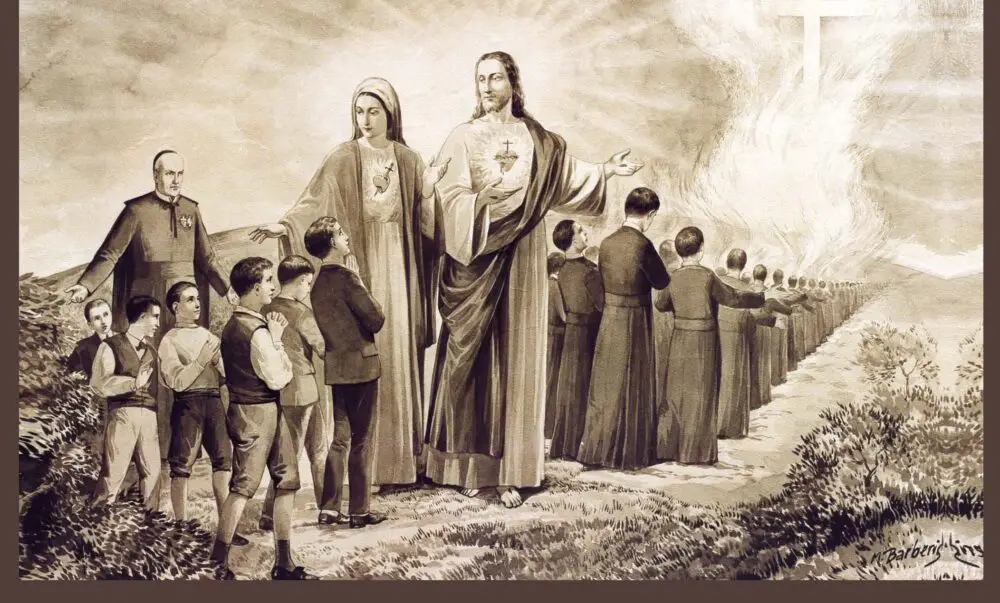
As we entrust ourselves to the Immaculate Heart of Mary, we are drawn ever closer to her Son. Her maternal love guides us to Jesus and teaches us how to live with faith, humility, purity, and trust. In her heart, God’s promises of redemption were received, cherished, and fulfilled in hope. United to her Immaculate Heart, we are led to the Sacred Heart of Jesus, where we encounter the fullness of God’s love and the promise of eternal life.
– Fr. Frederick Clement, m.ss.cc.
References
Lois Tverberg, Reading the Bible with Rabbi Jesus: How a Jewish Perspective Can Transform Your Understanding (Grand Rapids, MI: Baker Books: A Division of Baker Publishing Group, 2018), 257.
Gary C. Newton, Heart-Deep Teaching (Nashville, TN: B&H Books, 2012), 18.